Triduum Sacrum: Pascha I

Triduum Sacrum: Pascha I Acts 10: 34a, 37-43; Psalm 118; 1 Corinthians 5:6b-8; Luke 24:1-12
“their story seemed like nonsense and the apostles and disciples did not believe the women…”
[Luke 24:11] Was the story considered nonsense because it was women who made the report? Was the story not believed because it was so outrageous?
While the bible records that people, like the son of a widow, Lazarus or the daughter of Jairus, had been brought back to life from death; did you ever consider they all grew old and or became sick and died a second time. Until these women reported their experience at the tomb of Jesus no one had ever encountered something other than resuscitation. But Jesus was said to be “the living one among the dead” not the living one from the dead.
Many people, and regretfully Christians, confuse resurrection with resuscitation and resuscitation with death. How often have you heard comments such as, “My sister died on the operating table and the doctors brought her back.” Wow! I guess God should have just waited for humans through inquiry to develop science, medicine and surgery rather than be humbled as a human in Jesus of Nazareth, crucified for us. When I said his relative did not die and be brought back to life in surgery, a former parishioner became so angry with me and I never saw him again. Whatever happens on operating tables and in ambulances is not death and resuscitation, least of all resurrection.
Incidents like this have led me to wonder what in society and in the church underlies our understanding of death and life and the various movements that have developed, for instance:
The interest in producing books and television programing for adolescence about vampires and zombies, the half-dead; the living-dead. Why the flirting with death?
Why do many people have images of death tattooed on their bodies?
Why the rising interest in the occult?
Why the obsession with the issues of life and death from abortion and euthanasia, to all sorts of meddling to create life, contracept life, freeze life and save it for the future, and manipulate life, right down to our DNA? Much of this strikes me as acceptance of the serpent’s declaration in the Garden of Eden: “You certainly will not die! No,…you will be like gods…” [Genesis 3:4-5]
Why do more and more Catholics cremate their dead instead of encountering a lifeless human body, the dwelling place of the Holy Spirit?
Why do many Catholics, and people in general, desire “celebrations of life” rather than funerals? Is there no longer room for sadness, weeping and grieving in our life?
Though we would probably never admit to it publicly or to ourselves, are all these movements a reflection that we deny the reality of death? Is it our unspoken fear of death and the thought that death is oblivion? Yet we proclaim in the Creed, “For our sake Jesus was crucified under Pontius Pilate, he suffered death and was buried…”
These movements in society seem to strike at the heart of the meaning and purpose of human life. Do you feel your life has meaning? Or have many of us chosen to live life through the scientific method we comprehend and proved over a trusting relationship with God that we may not be so sure of since more and more people no longer believe in the existence of God. Our Christian claim is made all the more outrageous and nonsensical because, like all relationships, God and resurrection are not something to be proved through the scientific method of observation and conclusion. All we have is the word of witnesses beginning with a group of women intent on burying a friend with dignity and respect. A word of witnesses who were expecting to encounter death and were confronted by the possibility of the fullness of life forever.
Like the apostles, you may ask, what does it mean to rise from the dead or be the living one among the dead? I believe they are the wrong questions because they seek explanation rather than experience. It is said, “seeing is believing” but might it be that “believing is seeing”? Might it be that the eyes of faith and trust see and experience the world differently than society; see the world as deeply permeated by an inexplicable life that has exhausted and emptied death of any meaning. What do I mean?
When we bury the dead from terrorist attacks in Brussels, Belgium, we have hope of their eternal life with Christ.
When we anoint the sick and bring viaticum to the dying, we share with them in the suffering and death of Christ.

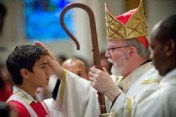

When we celebrate baptisms, confirmations, and First Communions, we give thanks to God for the powerful presence of the risen Christ in the ordinary acts of washing, anointing and sharing in a meal together.
When we celebrate weddings, we acknowledge that the Author of love has called bride and groom together in a permanent commitment giving us a glimpse of God’s commitment to each of us.


When we celebrate ordinations, we are grateful for those who have been called to share and take us up with them into the ministry of Christ, the Great and Eternal High Priest.
When we forgive the sins of others, we draw a person out from the darkness and power of spiritual death and experience our own rebirth.
When we gather on Sunday mornings, whether in great cathedrals or humble rural churches, we are nourished by the same Word and Sacred Meal of those first witnesses, giving thanks to almighty God, through our risen Lord and through his Spirit.

Is the story outrageous? Yes it is! It is because we cannot begin to understand or embrace the vastness of God’s love for us. To encounter such love, we first must allow ourselves to be loved and cared for by God and other people – a share in the love that has destroyed the power of sin and death over us.
Comments