Palm Sunday of the Lord’s Passion

Lent VI: Palm Sunday of the Lord’s Passion 2015 – Cycle B Isaiah 50:4-7; Psalm 22; Philippians 2:6-11; Mark 14:1–15:47


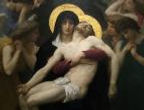
To “die with dignity” is one of the many catch phrases of our culture. Have you ever reflected as to what it means?
I expect for many people to “die with dignity” means a death without suffering – a peaceful death. In fact, the Night Prayer of the Church every day ends with the final petition: “May the all-powerful Lord grant us a restful night and a peaceful death.”
But is our cultural understanding of peace, a peace that is reduced to the absence of pain, emotional and physical suffering or the loss of cognitive and physical abilities, not empty? Is not this understanding closed to the possibility that suffering can intersect with love? Have you considered that this understanding of peace, consisting of an absence of pain and suffering, voids the virtue of compassion of its original depth of meaning?
Compassion, from the Latin, cum+passio, is not to avoid the experience of suffering but to co-experience suffering with another person. Consider that four of the twelve Stations of the Cross which line our churches offers us images of compassion, co-experiencing suffering with another person. There is Veronica wiping the face of Jesus hours after he had washed and dried the feet of his disciples and the women of Jerusalem weeping for Jesus along the Via Dolorosa, the Way of Sorrow. There is Simon of Cyrene literally walking the walk with Jesus and the inconsolable face of Mary, the mother of all who grieve, mourn and lament.
In this light, does not the term “dignity” mask the experience of death as an evil, a shattering of life, often a cruelty? …what Scripture calls, “the last enemy”? [1 Corinthians 15:26]
Ours is a culture ill-equipped to emotionally and spiritually encounter suffering or the face of death evidenced by how we consume the spectacle of death through our entertainment and news, and in the transition of funeral liturgies from rites of passage for the dead and the living to memorial services marked by balloons, teddy bears and eulogies devoid of sadness and mourning. Ours is a society that cannot and therefore will not encounter nor endure death disrupting our lives. It is therefore only a comfortable, first world; an adolescent culture such as ours that can even consider speaking of “dying with dignity.” The poor, the powerless, the victimized, the tortured, the hungry, the lonely, and the abandoned of the world never speak of nor experience such a death.
Jesus was aligned with these people throughout his life. Thus Jesus did notdie with dignity. He died by one of the cruelest and most barbaric methods humans have conceived to kill. Jesus died a shameful, humiliating death crying out the opening verse of Psalm 22, “God, why have you forsaken me?” And receives in response no answer but the abandoning silence of God.
Was Jesus’ death diminished because he endured suffering? Does not our culture answer with an affirming “Yes”!? Yet how many people throughout our world die, alone, violently, tortured, unjustly, without dignity?
The Presbyterian minister, Frederick Buechner put it this way: “Like Buddha under the Bo tree, Jesus, on his tree has his eyes closed too. The difference is this. The pain and sadness of the world that Buddha’s eyes close out is the pain and sadness of the world that the eyes of Jesus close in.” [The Life of Jesus, Buechner, Boltin, Weathervane Books, New York, 1974; page 13] The Crucified One thus offers us an alternative narrative to that of our culture and world; it is the narrative grounded in the logic of the Cross. This is a narrative in which suffering unto death can be penetrated and transfigured by the mystery of love.
Family, friends and even the stranger can be the crux, the still point, where suffering and love intersect. Even the unconscious, unproductive, unattractive, uncomfortable dying person can be caught up in the embrace of relationships; can be read to, washed, dressed and kissed; can be gently caressed, held and wept over. In other words the dying can be simply loved to the end. Is this not what we see in the image of the pietá?
Mother lovingly holding son. Humanity embracing divinity. Suffering participating and embracing suffering revealing compassion, beauty, sorrow, majesty, love…
“May the all-powerful Lord grant us a restful night and a peaceful death.”

[Ideas and phrases taken from On Dying Well, Jessica Keating, AMERICA Magazine, March 16, 2015]
Comments