top of page

Ordinary 4

Writer: David Wm. Mickiewicz
David Wm. Mickiewicz
Jan 28, 2022
8 min read

Updated: Jul 25

The Fourth Sunday in Ordinary Time

Jeremiah 1:4-5, 17-19; Psalm71; 1 Corinthians 13:4-13; Luke 4:18


Two months ago I pointed out that Deacon Paul’s seat was empty. Paul was in Hancock, an hour south of us. Saint Paul’s in Hancock has not had a resident priest – pastor in 1.5 years.  The laity are “minding” the parish. Paul was there to preside over a non-Eucharistic service for that community because no priest was available. For decades we’ve talked about a shortage of clergy. But the experience in the parishes is that a priest always shows up. That is no longer the situation.

At that time I told you I would like to speak with you as members of the Church about things that I think you need to be aware of and knowledgeable about for your reflection as we move into an the future. My remarks will consist of some facts followed by personal observations.

We Catholics clearly understand our church as local, that is, the parish, and universal, our connection with the worldwide church through union with the pope, the Bishop of Rome. But are we as cognizant of ourselves as part of the Diocesan Church? Albany and the bishop seem distant to us. Yet our local church is the Church of Albany gathered around our bishop, Edward.


The Diocese of Albany was established by Pope Leo XIII on 23 April 1847. We encompass 10,419 square miles consisting of 14 New York State Counties, The general population is 1,400,000 people of which 306,500 are Catholic, about 22% of the population. And for a variety of reasons both understandable and not so, not all of the 300,000+ Catholics participate in the life of the Church. I expect ¼ to ½ do in some regard.
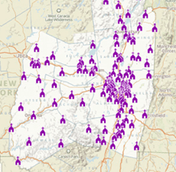

The Diocese consists of 126 parishes. As you can see most parishes are clustered in the Tri-cities area of Albany, Troy & Schenectady and along the Mohawk and Hudson River valleys attesting to our 19th century history of canal and river use for the economic life of the State.


Like a State is divided into Counties, so a Diocese administratively is divided into Vicariates. There are 7 Vicariates in our diocese and we are located in Leatherstocking which consists of the counties of Schoharie, Otsego and Delaware, about ¼ of the land mass of the diocese. Looking again at the map of parish locations you can see how scattered parishes are in our vicariate in contrast to the river valleys.

Some statistics. The diocese is comprised of 126 parishes, 25 schools: elementary, high, private; 4 colleges; 14 chapters of campus ministry; 3 hospitals, 6 convalescent home, and 15 communities of senior housing; 12 social services agencies, and 6 retreats houses.

Presently there are 157 priests / 96 retired, 25-30 of which are full-time retired; the average age is 80. The retirement for priests by Church law is 75, most retire at 70, in the next 5 years 12 priests reach 70. There are 110 deacons, 80 active.

Statistics only offer us a limited view of any situation. My observations arise from reflecting on my experience of the church for over 37 years.

I remember at Easter my grandmother baking a huge paska, a very large bread for Easter. She used Fleischmann’s yeast, those little cubes. A little yeast is all it takes to affect the dough and make it rise. Dough on the other hand doesn’t affect anything.

I’ve had to ask myself whether God, in the First World, is using our present situation of decline for the past half century to return us to being yeast: small but effective. For generations and centuries we have been dough. I note, the First World, because we tend to shortsightedly think that our Catholic experience is that of the entire Church. It is not.

Teresa of Kolkata’s observation of the First World is that we suffer from “too muchness.” We have too much of everything at our disposal and therefore might not think we need God. In our present time then, we – the ‘dough’ have become irrelevant in many people’s lives. We all have experienced this in the departure from our Catholic Church of our children and grandchildren, relatives, friends, neighbors and fellow parishioners.

There is hope though as one of our senior parishioners has stated; we may be becoming a smaller church but we will be a more vibrant church. She clearly understands that God took the crucifixion of Jesus and transformed it by resurrection into salvation and eternal life.

Might God be using the sexual abuse scandal, clericalism, and the disruptions caused by the Holy Spirit through the Second Vatican Council to renew the Church by separating chaff from wheat?

Do you consider yourself wheat or chaff? Wheat, which has substance to it, falls to the ground and stays. Chaff, flies off with the breeze.

In that light, did you know that when the Diocese has had to close a parish or merge a number of parishes that 1/3 of the parishioners stop participating in living out their faith, 1/3 remain in the life of the church and in their sadness and mourning join themselves with other Catholics to move forward in faith and 1/3 join other Christian denominations? So 2/3 leave the church.

During the course of my priesthood, I have had to close 2 parishes and a school. I’ve watched. I realize that these are not just buildings. These walls are filled with years of prayers and memory: First Communions, Christmases, Funeral Masses, Baptisms and Weddings but… And the ‘but’ is important. Churches house the People of God; they are not the People of God.

On the other hand, I do not fully understand the situation since my elementary school is closed and sold; high school closed and razed; college music department closed, first seminary closed and sold, 2nd seminary closed & relocated. I have not regularly worshiped in the parish I grew up in for over 40 years. In fact, to go back to Saint Michael’s is a little awkward for me. Because you can’t go back.

That is why God did not ask for a Temple to be built but was satisfied with dwelling in a tent. A tent that folds up and journeys with the People. It is the gathering of the People of God that is the dwelling place of God just as we did in the cemetery two summers ago at the beginning of the pandemic. That gathering was Saint Mary’s Parish sans building. We need to consider then, how do we creatively strike a balance between building, memory, history, future and people?

Did you know that Catholics more than any other aspect of parish life are attached to the Mass time they attend? Catholics will travel farther and use up more time to attend a particular Mass time rather than worship in their own parish.

Consider how people responded just from changing the Vigil Mass time from 4:00pm to 5:00pm. How will you respond when, and I mean when, we only need one Mass on Sunday?

These examples raise questions for me about our commitment to Jesus Christ, the local parish community and the place of Christian Faith in our people’s lives.

Our culture is dominated by consumerism. What these observations say to me is that many Catholics view their faith through the lens of a consumerist model. What I can’t get at this store, I’ll seek out at another store or simply stop shopping. In such a situation you have a very unstable faith in which Jesus is not at the center. This is what I mean when I say we have become ‘dough’.

In conjunction with this we see fewer and fewer people coming forward for Baptisms, Marriages and Funeral Masses. Families call up for First Communion and Confirmation but otherwise are absent from the parish’s life. I preside over Funeral Masses, if there is a Funeral Mass, of congregations with little to no response as we worship. People’s idea of community has been reduced to their immediate family members and friends. Services often are private for many Sacraments. The whole parish community of faith is not considered people’s community and our presence is not desired.

Sacraments are not private events but encounters with the whole risen Christ, head and body, embedded in the gathered people.

Even though Vatican II gave us the image of a Pilgrim People of God rooted in baptism, we are still a very clergy oriented church. Yes, vocations to Holy Orders and vowed religious life are a necessary part of the Church’s varied life. And yes, such vocations have been declining for decades but so have vocations to teaching, nursing and the medical profession.  Something more is happening in our society, is it not? Dough – too muchness?

But is vocations to Holy Orders and religious life the prime issue. Might God be forcing us to look at the fundamental vocation of all baptized women and men of the Church? Pope Francis reminds us that is it the Lord who send vocations. Maybe we are overflowing with vocations; the vocation of lay single and married life? Pope Francis has said if we look only to sociological reasons to explain why religious vocations are drying up we will only have “half the truth”. He sees the lack of religious vocations as a moment for soul-searching and reform. We need to ask ourselves, what is the Lord trying to teach us in this lesson? For Francis it is the lesson of humility. If humility is the lesson, than yeast is an image we need to reconsider as a mark of a follower of Christ. Small and humble but effective.

At the Exodus, when the Israelites arrived at the Reed Sea, the people were angry and frustrated.  The uncross-able sea is before them and Pharaoh and his army are bearing down on them. They cry out to Moses demanding why God had led them into the desert to die. God’s ultimate instruction to Moses? “Tell the people to go forward!” [Exodus 14]

The Talmud, a Jewish commentary on the biblical writings offers a thought provoking interpretation of the scene. It says that it was a young person who first began walking into the waters. They walked until they were chest deep before the waters of the sea began to split and open unforeseen pathways.

This story of ultimate trust in God even when we do not see possible pathways forward is essential for us today.

I close with a challenge to you, the People of God. I believe that we priests are shackled by the sexual scandal, clericalism, theological divisions between generations of priests and a lack of imaginative and courageous leadership from our bishops. We are seen as irrelevant and are voices reach few.

One of the great movements of the Second Vatican Council was a reclaiming of Baptism as the fundamental Sacrament of believers which calls every Catholic to be responsible for their personal spiritual lives and for the life of the Church. In this light, I believe that we have entered a period in the Church’s life when the laity need to take up the guidance of the Church. That is, laity listening and talking with, encouraging and challenging each other. This is a pathway to a more vibrant church. And not a larger church but an effective church.

We will only be the Church of Jesus Christ when laity and clergy stand shoulder to shoulder as equals both fully responsible for the Church.

The Irish and Scots use the word “minding” a lot. “Who’s going to mind the child?” or “Who’ll mind the place when I’m dead?" It means “caring” or “nurturing.” In a Church that often seems to be teetering on the brink of irrelevance, I believe we must ask you the women and men of the Church to help “mind” the store, the Church. To really nurture and care for it. This means taking responsibility and being very brave in your faith. It means having the trust of a young person who is willing to walk chest deep into a sea not knowing what will happen but trusting that something will happen.

Thank you your attentiveness and please pray and reflect on my thoughts.


Recent Posts

See All
Pascha II

The Second Sunday of Easter Acts 4:32-35; Psalm 118; I John5:1-6; John 20:19-31 Are you caught up in Eclipse Mania? Do you have your solar glasses to protect your eyes? Are you gathering with friends


Pascha I

Easter Sunday: The Resurrection of the Lord Acts 10: 34a, 37-43; Psalm 118; Colossians 3:1-4; John 20: 1-9 Three weeks ago, early in the morning on the first day of the week while it was still dark, m


Lent V – Laudato Si’

The Fifth Sunday of Lent The fifth and final homily in a Lenten series on the Encyclical Letter, Laudato Si’ of Pope Francis. Each year on St. Patrick’s Day, tens of thousands of Americans add green t


Comments


© 2026 David WM. Mickiewicz | On the Margins

All rights reserved.

bottom of page