Ordinary 32

The Thirty – Second Sunday in Ordinary Time 2019 – Cycle C 2 Maccabees 7:1-2, 9-14, Psalm 17, 2 Thessalonians 2:16 – 3:5; Luke 20:27-38
Last Sunday I began a discussion on the Sacraments of Reconciliation and the Eucharist. I asked you to reflect on your past experiences of the Sacrament of Reconciliation and whether you experienced God’s forgiveness in ways other than that Sacrament. I offered you the analogy of Pope Francis and Saint Ambrose that these Sacraments are medicine for the soul.
Medicine for the soul. How often Jesus links the physical healing of a person with the forgiveness of their sins. Consider the healing of the man suffering from paralysis.
“When Jesus saw their faith, he said to man who was paralyzed, “Courage, your sins are forgiven.” At that, some of the scribes said to themselves, “This man is blaspheming.” Jesus knew what they were thinking, and said, “Which is easier, to say, ‘Your sins are forgiven,’ or to say, ‘Rise and walk’? But that you may know that the Son of Man has authority on earth to forgive sins”—he then said to the man who was paralyzed, “Rise, pick up your stretcher, and go home.” [Matthew 9:1-8]
Jesus came to heal the whole person, soul and body.
So much so that Jesus forgives and gives an excuse for those who are crucifying him. “Father, forgive them, they know not what they do.” [Luke 23:34] On the evening of the Resurrection appearing to his frightened disciples, “he breathed on them and said to them, “Receive the holy Spirit. Whose sins you forgive are forgiven them, and whose sins you retain are retained.” [John 20:23-24] Jesus gives his healing authority to the Church.
Healing is at the heart of Jesus’ life and ministry. Jesus never seems concerned about the sin or its seriousness. He simply encounters a person in need of healing. Consider the criminal crucified with him, the woman caught in adultery, the woman of Samaria or Zacchaeus. Jesus simply says that he came to seek out and save what was lost and does so. Have the Church’s prayers, and the Sacrament of Reconciliation in particular, always reflected this attitude of seeking and finding?
In her self-reflection, the church does make a distinction that not all sins carry the same weight or have the same effect on our spiritual lives. We have traditionally spoken of “venial” – forgivable sins and “mortal” – deadly sins, which are also forgivable. The First Letter of John speaks of a sin that leads to spiritual death as opposed to a sin that does not lead to spiritual death.
In speaking of the Eucharist, Saint Paul writes that whoever “eats the bread or drinks the cup of the Lord unworthily will have to answer for the body and blood of the Lord. A person should examine themselves…” [1 Corinthians 11:27-28] However the Catholic Church has understood this spiritual death and this kind of unworthiness to reflect a person who has committed mortal sin; a wholehearted, deliberate rejection of God that separates a person from God and the community. So serious is this grave and willful spiritual decision to reject God, that the Council of Trent taught, a person must confess such sins to a priest or bishop.
I have to wonder, if such a wholehearted and deliberate decision is needed for a sin to be deadly, might this be something the average parishioner and cleric may never be tempted to make in a lifetime?
So what about lesser sins that daily plague all of us?
I asked you if you experience God’s forgiveness in ways other than the Sacrament of Reconciliation.
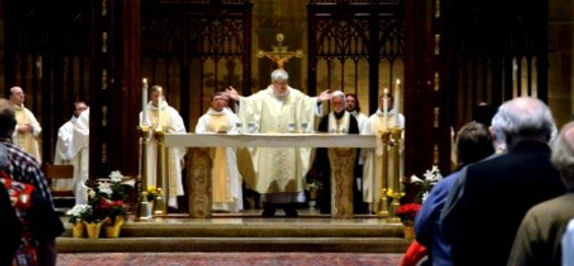
Did you consider the liturgy; its language is rich with pleas for God’s merciful forgiveness.
The singing of Kyrie eleison, Lord, have mercy, Christ have mercy.
The acknowledgment and taking personal responsibility for our sins in the words “though my fault, through my fault, through my grievous fault”. A spiritually and psychological mature response.
How many of you bless yourselves when I pray, “May almighty God have mercy on us, forgive us our sins, and bring us to everlasting life” because you hear it as an absolution?
In the singing of the Gloria we praise Christ as the one who takes away the sins of the world, “…receive our prayer, …have mercy on us”.
At the center of the Eucharistic Prayer we hear Jesus’ own words, “Take this…and drink from it…my blood which will be poured out for you…for the forgiveness of sins.”
And just prior to the reception of Communion the words cascade over us, “forgive us our sins as we forgive those who have sinned against us”…“Deliver us…from every evil…that by the help of your mercy we may be always free from sin….” Lamb of God, you take away the sins of the world, have mercy on us…Lord, I am not worthy … say the word and my soul shall be healed.”
It is hard for me to believe that for our lesser sins God would refuse these prayers sincerely prayed by the Body of his Son, the Church. And is not Holy Communion itself, humbly and properly received, the forgiveness of our sins?
Consider the following means of the forgiveness of sin.
Saint Augustine wrote, “For the passing and trivial sins of every day, from which no life is free, the everyday prayer of the faithful makes satisfaction. For they can say, “Our Father who art in heaven…”. This prayer completely blots out our minor and everyday sins.” [Faith, Love and Hope, Saint Augustine, para #71]
The Book of Tobit offers two forms of forgiveness. “Prayer with fasting is good. Almsgiving with righteousness is better…for almsgiving saves from death, and purges all sin”. [Tobit 12:8-9]
“Above all, let your love for one another be intense, the First Letter of Peter instructs, because love covers a multitude of sins.” [1 Peter 4:8]
The Lord’s Prayer, the Eucharistic Liturgy, almsgiving with righteousness, intense love of neighbor, the Sacraments of Reconciliation and of the Anointing of the Sick, prayer with fasting, a sincere Act of Contrition all forgive sin.

Did you consider how often we forgive the sins of each other? The sins between spouses, parents and children, friends? Some of these we overlook without a second thought because of our love for those people and others. Why do we think differently about God’s love for us?
None of this diminishes the importance of individual confession to God through a priest who makes Christ present in the Sacrament of Reconciliation. Such an encounter in prayer – not the three-minute quickie – can lift crushing burdens of the past that have been left unhealed, assist in dealing with habitual sins or simply offer some spiritual counseling.
As the Season of Advent and the Feasts of Christmas approach, think upon these things. Christ comes to us as the Christmas carol sings, “Ris’n with healing in his wings…Born that we no more may die…Hark! The herald angels sing, “Glory to the newborn King!””

Comments