Ordinary 29
- David Wm. Mickiewicz

- Oct 16, 2021
- 3 min read
The Twenty-Ninth Sunday of Ordinary Time
Isaiah 53:10-11; Psalm 33; Hebrews 4:14-16; Mark 10:35-45
All human beings suffer. No one escapes. Suffering is part of the human condition. What is at the heart of your suffering? Yes, at the heart. That is where the pain is most felt, is it not?
Is it an ungrateful child? A deep and painful regret? An inability to let go of the past as you replay the tapes over and over again in your head unable to get out of the loop? An unrelenting anger? Are you suffering the burden of grief over the death of a person, a hope that has been shattered? Is it the experience of sexual, emotional or physical abuse?
An unresolved fear, perhaps? Do you suffer from the expectation of always needing to be the best, the first, the smartest? Is it the sense of helpless in the face of an addiction? The unique suffering of people with mental illness? A sense of failure arising from a divorce? Chronic physical pain?
Are you suffering from having too much? Do you feel no one cares about you? Do you suffer the burden of loneliness? Are you worrying about your daughter or son? Parents never stop worrying, do you? Is it a physical infirmity? The loss of youth? Do you find yourself in the latter half of live burdened by whether your life has had value? Is it the suffering of betrayal? In this pandemic, are you experiencing a restlessness or a sense of being lost?
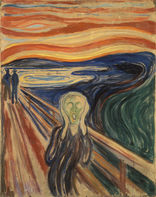
How much of your suffering is like Edvard Munch’s painting of a silent scream? No one knows or hears. Have you therefore considered whether your suffering has value and purpose?
Consider the servant of God in the passage from the prophet Isaiah.
If he generously gives his life as an offering for sin, he will see his descendants in a long life.Because of his affliction, my servant will be glorified.Through his suffering he will atone for sin and many people will be brought to salvation.
Who is Isaiah referring to? Who is this servant of God? We do not know.
Reflecting with a deep concentration and a deliberate focus, the Christian community has seen in these images of suffering and future promises of fullness a truth of the human experience so profound that this passage in its extended form is proclaimed on Good Friday. For Good Friday marks more than the passion, crucifixion and death of Jesus. It is about human suffering. It is about our suffering; our suffering being taken up and bound to that one act of suffering in Jesus.
In this act of suffering The Letter to the Hebrews calls Jesus a great high priest. A priest offers sacrifice. But in the case of Jesus, he is not only the priest but also the sacrifice. Jesus is a priest who becomes broken and suffers like his sisters and brothers to be the source of healing for his brothers and sisters. If that is so, does not our suffering in union with Jesus therefore not have value when steadfastly endured in faith?
God does not take pleasure in the pain suffered by his sons and daughters. What is important is a faithfulness to God and dedication to each other in the midst of our suffering and pain that has value and makes us sharers in the redemptive act of Jesus. We are not just recipients but participants in the act of redemption that is made present at every gathering for the Eucharist. Thus our presence and full, active participation in all aspects of the Eucharistic Liturgy are not only essential but demanded of us to take away the sins of the world.
Our suffering is bound up with the suffering of Jesus. Our prayers are joined with his cries of abandonment, forgiveness and resignation from the cross. Our faithfulness is mingled with his fidelity.
If he generously gives his life as an offering for sin…”
Who is Isaiah referring to? Who is this servant of God?
It is Jesus whose arms on the cross embrace our suffering and whose closed eyes take in the pain and brokenness of the world. And each time we endure our suffering with generosity, love of neighbor and fidelity to God we join ourselves to Jesus crucified.
Does a crucifix mark your Christian home? If not, consider obtaining one. Put it in a conspicuous place of honour. See in the image not just a past event but your present suffering bound to Jesus. Come to see your suffering as sharing in healing this world and making it holy.
Comments