Ordinary 19

Aug 5, 2021
4 min read
Updated: Jul 30
The Nineteen Sunday of Ordinary Time
1 Kings 19:4-8; Psalm 34; Ephesians 4:40 – 5:2; John 6:41-51
The third homily in a series on John 6.
Just a couple of weeks after dad died was Easter Sunday. I arrived home and mom had set the table as usual – for the four of us. But there weren’t four of us anymore. All the glasses were to be filled with wine. No one said anything but everyone knew not to sit at the head of the table where dad had sat for years.
I expect many of you have had that same experience of absence – and presence – at the first family celebrations after a loved one has died.
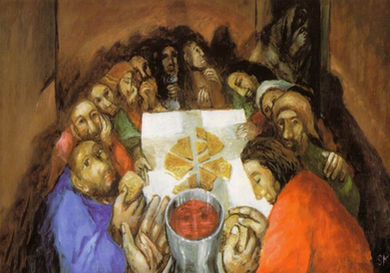
As we look at Sieger Köder’s painting there is an absence and a presence as well. We cannot see Jesus. We are viewing the disciples from Jesus’ vantage point as if sitting in the place of the Master. No one said anything but everyone knew not to sit where dad had sat for years. I wonder why Köder placed us in this perspective?
A hallmark at times of Köder’s artistic and theological insight is to infer Jesus’ presence. He does so in this painting through Jesus’ hands which surround the cup and through a reflection of the face of Jesus.
The atmosphere is somber as shadows hover across the back wall of the room outlining the disciples. Absent is the rejoicing, camaraderie, and children that usually mark a Passover table. Rather there seems to be a sense of loss and sadness.
The faces of the disciples range from wondering what is happening to some who are falling asleep. One disciple at the other end of the table is looking surprised at someone who is leaving. Is it Judas? The darkness foreshadows the betrayal and denial that are not far away. A tremor of fear and uncertainty passes through the gathered disciples.
Jesus has broken the matzah. The pieces of unleavened bread scattered on the table form the first two Greek letters of the title Christ, ‘christos’ – the anointed.’ The Greek Chi Rho look like the Latin letters X and P. The shadow of a cross is seen on the table cloth with the broken bread at its center.
Whether the Jewish Passover or the Christian Eucharist, these sacred meals are weighted down with a complex array of meanings and emotions: slavery, thanksgiving, freedom, flight, oppression, a leaving, the unfamiliar masquerading as the familiar, bread that is broken and shared, sadness, guilt, life, presence, death, [whether of the first born of Egypt or the Only – Begotten of God], sin, a new future, community, sacrifice, darkness, a lamb, blood, bread from heaven, cross, mystery, eternal life, wine, innocence, redemption, fear, salvation, and questions.
There are always questions.
The youngest child begins the Passover Seder by asking, “Why is this night different from all other nights?” The Hebrews in the desert ask, “Why did you lead us into the desert to make us die of famine?” The disciples ask, “Where can we buy enough food for the crowd to eat?” The people murmur, “How can this man give us his flesh to eat?”
Is our Sunday gathering for the Passover Eucharist any different?
A mixed assemblage of motley people, like the tribes of Israel, bringing our varied meanings and questions as we gather around a common table. Bread is broken like so many of our lives. Like the lives of slaves. Life blood is poured out as many of us do for others. Like the prophet Elijah.
We hear words, “I am the bread of life.” This is my body.” “This is my blood.” “Get up and eat, else the journey will be too long for you!” The Holy Eucharist, ‘bread from heaven’, ‘manna’, the ‘Lamb of God’, is food for a journey. But a journey where…? Is the journey toward God? …toward each other? …into the world?
Elijah will walk to Mount Horeb in the desert where God made his Covenant with Israel. Israel is journeying through that same desert in search of a land of promise. Jesus will soon be stumbling in a desert of pain up Mount Calvary.
“Get up and eat, else the journey will be too long for you!”
So, toward whom or what is the journey of your life leading you? Where in this pandemic are we going as a parish community? Are we wandering aimlessly like Israel in the desert? Have we had enough, as voiced by the prophet Elijah, and just want to through in the towel? Are we wondering, like the disciples, what is about to happen? Whether a singular or community journey…
Whether feeling frustrated, fearful or filled with anticipation… Whether we fully understand this meal or not… It is Jesus who gathers us each Sunday to offer us food for our journeys.
In Köder’s painting, the eyes of the disciples are on Jesus. Jesus’s eyes, reflected in the wine of suffering and the outpouring of blood, are on us. It is as if Jesus and we are one in this painting. A mirror image. Köder has us see the world from the same perspective. But isn’t that what Holy Communion is about? That we become one with Jesus and with each other?
I arrived home and mom had set the table as usual – for the four of us. But there weren’t four of us anymore or was I wrong…a mystery of great wonder…a holy communion.
_______________________________________________________________________________________
Images, passages and ideas are from Magdalen Lawler, a Sister of Notre Dame from her book, Love Bade Me Welcome: Reflections on the Eucharist in the Art of Sieger Köder, Pauline Books and Media, 2016. http://www.PaulineUK .org
Comments