Ordinary 17

Jul 24, 2021
4 min read
Updated: Jul 30
The Seventeenth Sunday of Ordinary Time
2 Kings 4:42-44; Psalm 145; Ephesians 4:1-6; John 6:1-15
The first homily in a series on John 6.
I have recently discovered the art of a German priest by the name of Sieger Köder [1925 – 2015]. His brilliantly coloured and sensitive paintings always draw our contemplative gaze toward the central figure of Jesus. Over the next weeks as we listen to the 6th chapter of John, which I encourage you to read and reflect on in its entirety, I will be using Köder’s paintings as a source for reflection on the Eucharist.
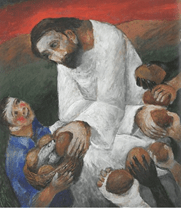
The story of the miraculous feeding of the crowds opens chapter 6 and John uses that event to set the scene for a challenging teaching of Jesus that will call forth from each of us a decision.
As we look at the painting we see Köder’s focus is not on the vast crowd but on the encounter with the young boy. The eyes of the boy and Jesus are caught in a wonderful mutual gaze. The boy’s red cheeked face is filled with delight as he gazes into the care worn face of Jesus. It is the end of a long day evoked by the red sunset in the background. Jesus is tired. The crowd is hungry.
Dressed in a bright blue modern T-shirt [he can be any girl or boy we choose] the youngster offers the makings of a picnic. There is something carefree about a picnic and the youngster sees an opportunity for some enjoyment.
Children see the world differently than adults. Jesus understood that. So he taught that the qualities of children are necessary to enter the Reign of God. Even the coldest heart of a stubborn, narrow, miserable adult melts and smiles in the presence of an infant or a young child.
What do you think there is about children that mark them out as the presence of the Reign of God?
The disciples Philip and Andrew as well as the servant of the prophet Elijah stumble in their doubt. It is the youngster who is presented to us as the person with faith. Jesus and the boy see an opportunity. The disciples see a problem.
As we mature and age, why do you think many people give up those childlike qualities of miraculous possibilities? Why do we rather choose to see the world through negativity, practicality and a narrowed vision?
If that is true and I believe it is, the hunger that the people are experiencing, that we are experiencing, may be more acute and much deeper than what bread and fish will satisfy.
But the story is not about fish and bread, is it.
Look at how many hands fill the canvas. Hands that are offering, receiving, and outstretched in need. For what purposes do you use your hands? In the painting, the outstretched hands come from many circumstances. They are brown and black, bandaged and beige, wounded and young. They all reach out. And notice that every hand is filled. No one is left empty handed. Everyone is to be satisfied.
For those of you who have not been a Eucharistic Minister you have not experienced the sight of empty hands reaching out before you. Hands that are supple, hands embedded with oil and dirt from years of manual work; hands that are worn and petite, calloused, large, arthritic… Faces, like Jesus in the painting, which are tired and worried; hungry people. The act of distributing Holy Communion into another person’s hand is itself a spiritual experience. It is an opportunity to see as Jesus sees each of us.
In light of this hunger and neediness, like the five loaves and two fish, the Communion wafer seems so meagre to nourish the burdens that many people are carrying in life.
But the story is not about fish and bread for the body, is it.
Like the youngster in the bright blue T-shirt we offer our gifts of bread and wine which the priest places on the altar. I invite you with the words, “…pray with me that this our sacrifice may be acceptable to God the almighty Father.” And you respond, “May the Lord accept the sacrifice at your hands…”
Did you ever consider that God does not accept our sacrifice? In the face of our sins, evil and death, in the face of our fears, doubts and questions, our pain and burdens, what good are wine and bread?
Remember, Jesus knew what he was going to do. Like the few fish and loaves are multiplied beyond the boy’s imagination, so too our meagre sacrifice of wine and bread are transformed by the Spirit into the living, true, and real Body and Blood of Jesus Christ which the Church acknowledges in her prayer IS, “the sacrifice acceptable …which brings salvation to the whole world.” That acceptable sacrifice, the death and resurrection of Christ, is what is offered to God at the conclusion of the Eucharistic Prayer. Thus our presence and participation in the Sunday Eucharist affects the entire world. Just like the basket of bread and fish satisfied the entire crowd gathered around Jesus.
In the painting we see the crossed arms of Jesus taking with one hand what is insufficient and unacceptable and giving with the other hand what is acceptable and sufficient for our life and souls.
Because the story has never been about fish and bread.
_______________________________________________________________________________________
Images, passages and ideas are from Magdalen Lawler, a Sister of Notre Dame from her book, Love Bade Me Welcome: Reflections on the Eucharist in the Art of Sieger Köder, Pauline Books and Media, 2016. http://www.PaulineUK .org.
Comments