Ordinary 13

Jun 30, 2018
5 min read
Updated: Sep 30
The Thirteenth Sunday in Ordinary Time
Wisdom 1:13-15, 2:23-24; Psalm 30; 2 Corinthians 8:7, 9, 13-15; Mark 5:21-43

I have often thought as I’ve observed the rapid rise and acceptance into main stream society of tattooing, how often the skull and other symbols of death are chosen by people, especially our younger generations. What might a person be conveying about themselves and how they view life to put such images on their body?
Why do well educated women and men from various countries travel to the Middle East to join ISIS? The angst and violence found in young Palestinian men, who are unemployed and whose leaders have led them to political dead ends, seems to be more than a yearning for a Palestinian State. Have you noticed that all the school shootings in our country are young males? Have you ever considered why that is so?
While taken with the wonder of technology, why are so many of us attached to our IPhones? Many of them are on 24/7 near our dinner plates and our night tables and we check them on an average of nearly 200 times a day even when they don’t ring? Who are we looking for? What are we looking for?
I want to ask, who decided that our daily worlds should be filled with screens; from physician’s offices to gas pumps, funeral homes to entrances of churches, stores to our own hands – (a phone is a screen)?
In last week’s New York Times, Clay Routledge, a professor of psychology at North Dakota State University, wrote an article in regard to the rise of suicide in our country. And while understanding that suicide involves a crisis of mental health care and getting needed services to people, he posited that another consideration in the rise of suicide is a crisis of meaninglessness.
Symbols of tattooed death? Violence as an expression of hopelessness? The constant drawing of our attention by phones and screens so that we are misdirected from reflection on our lives and their meaning? Are these not all expressions of meaninglessness?
We humans are unique among God’s creatures because we have the capacity to reflect on ourselves, to think about the past and the future. We understand that pain, disappointment and death are a part of life; that life is uncertain. Consider the journalists of “The Capital Gazette” who simply went to work on Thursday.
What is the point of it all? Can we understand why people hold a nihilist view? That there is nothing and life is worthless?
As Christians, what do we have to offer each other and the world?
How do we find meaning and purpose in life?
Meaning in life is more than simply being around people, we need to feel valued by people, to feel we are making an important contribution to our world, our parish, our town, our family, our school. Consider all the lonely people who walk our shopping malls. Being surrounded by people is not enough, merely pleasant social encounters are not enough to stave off despair which leads to hopelessness and meaninglessness. We are less likely to know are neighbors than previous generations, our families are smaller and scattered and religion is in steep decline. All avenues that in past generations gave people meaning and purpose.
Into our present situation the Book of Wisdom tells a different story.
Life does not happen by chance and death does not have the last say. “God did not make death…God formed the human being to be imperishable.” We are immortal and that has been confirmed by the resurrection of Jesus Christ. “God fashioned all things that they might have being and life and the creatures of the world are wholesome…”
Consider the refrain throughout the creation story of Genesis.
“Then God said, “Let there be light,” and there was light. God saw how good the light was.”
God continues creating and on the second day, “God saw how good it was.” On the third day, “God saw how good it was.” And on the fourth and the sixth day. At the completion of creation God found what he made was “very good.” This is not intended as a scientific explanation. Genesis is a statement of faith.
The person who says that hell is this world is a liar!
Take a look around our world. Reflect on your life and consider all the good that is present in beauty, in creation, in art and music, in people, in advantages and blessings you have had, consider your children and grandchildren, the stranger who in passing offered you a gift from God, your employment or retirement, health or the people who care for you in infirmity and sickness…“God saw how good it was.”
We Christians should be in the forefront of pointing out the goodness of this world and declaring that evil and death do not have lasting power over us. Where is our faith?
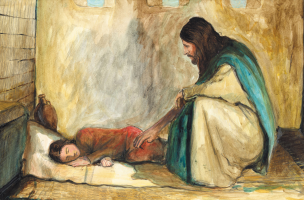
Consider the double story in today’s Gospel.

Both the woman and the little girl are linked by illness and time. The woman who has been taken advantage of and suffering for twelve years is the length of life of the dead girl. Women are not valued in ancient Israelite society and from the present charges of sexual harassment are not valued much in our society. Because of the woman’s bleeding she was to remain on the fringes of society, unseen, not a public person. Can we understand her desperation and the courage it took to force herself and

Comments