Lent IV

Lent IV 2015 – Cycle B 2 Chronicles 36:14-16, 19-23; Psalm 137; Ephesians 2:4-10; John 3:14-21


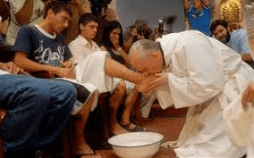
There seems to be in our time a rediscovery, a reawakening of what is at the heart of the Gospels. On 30 November 1980, two years into his pontificate Pope John Paul II wrote to us his second encyclical entitled: Dives in Misericordia(Rich in mercy…) examining through the biblical parable of the Prodigal Son both God’s mercy and the need for human mercy.
In the Jubilee Year of 2000, John Paul instituted the Feast of the Divine Mercy on the Second Sunday of Easter rooted in the devotion revealed by Sister Faustina Kowalska.
In 2013 Walter Kasper, a German Cardinal and president emeritus of the Pontifical Council for Promoting Christian Unity wrote the book, Mercy: The Essence of the Gospel and the Key to Christian Life. The book has been read and recommended by Pope Francis.
Since his election in 2013 Pope Francis has repeatedly spoken about and by his actions has shown us examples of mercy.
Can anyone forget the image of Francis kissing Vinicio Riva, the man disfigured with neurofibromatosis leaving him completely covered from head to toe with growths, swellings and itchy sores? Is it not reminiscent of his Assisi patron kissing a leper? Or the inmates, female and male, Muslim and Christian, whose feet have been washed during the Evening Mass of the Lord’s Supper on Holy Thursday? A rite that has taken place not in the ancient patriarchal basilica of Saint John Lateran but in Casa Del Marmo Jail and in the Don Gnocchi Center, a home for the elderly and disabled in Rome. One has to wonder where Francis will be this Holy Thursday evening and with whom? What is regrettable in this instance is the judgment upon Francis from some corners of Catholicism because he is not following the liturgical rubrics that twelve men have their feet washed. Women are still taboo in parts of our church and rubrics reign. In the light of 9/11, the rise of Islamic terrorism and the brutality of ISIS, does it not grate that some of these people are Muslim? For the self-righteous and people with nationalistic tendencies not much has changed in 2000 years when Jesus was seen eating with tax collectors, prostitutes and people of ill repute, in other words, outsiders. Curious that we never take into account Jesus continues at every Eucharist to eat with the same kind of people today! Francis is aware of this attitude among us when he preached, “I think we too are the people who, on the one hand, want to listen to Jesus, but on the other hand, at times, like to find a stick to beat others with, to condemn others. And Jesus has this message for us: mercy.” — Homily on 17 March 2013. Francis underscores the mixed realities of self-righteousness and spiritual thirst, of justice and mercy. But, what is mercy? Cardinal Kasper expresses mercy as the self-reflection of God, a mirror of our being. To be God is to be merciful. To be created in the image of God is to reflect back the divine mercy. “Am I my brother’s keeper?” [Genesis 4:9] Yes we are! Yet…
Which do you consider the higher quality, justice or mercy?
For how many of us is mercy often considered weakness, as unfair, because the scales of justice are not balanced? Someone is getting away with “murder”(?). Is mercy about fairness?
Consider the criminal crucified with Jesus. “Jesus, remember me…Today you will be with me in Paradise.” [Luke 23:42-43]What of the women caught in the act of adultery? “Has no one condemned you?” [then] “Neither do I condemn you. Go, [and] from now on do not sin any more.” [John 8:10-11] Is Jesus’ response in these situations justice, mercy, a mixture? Do these individuals get away with “murder”, as we say? Consider the present trail for Dzhokhar Tsarnaev, one of the two Chechen brothers who planted the bombs at the Boston Marathon 15 April 2013 which killed 3 people and injured over 260 people. Tsarnaev has admitted to participating in the bombing. He is guilty of the act. Where is justice for this case and where can mercy be administered? Should mercy be administered? The problem with the scales of justice is that they are cold and impartial. They freeze a human life at a particular moment in time. The Christian scriptures and tradition teach that justice is the minimum of mercy. On the other hand, mercy thaws life and embraces the totality of what a person lived and their relationship to the community. Is our life to be summed up by one act or is there not more to each of us?
When Francis washes the feet of inmates, women and men, Muslim and Christian, we know his answer.
When he suggests that divorced and remarried Catholics might be able to come to Communion and questions how this can be facilitated in church practice, we know his answer.
When he is questioned about gay priests and states, “If someone is gay and he searches for the Lord and has good will, who am I to judge?”, we know his answer.
It is not that the pope has all the answers for us; no one Christian does, not even the Pope of Rome but what we are witnessing is that Francis is publically searching, wandering, and questioning to find the path of mercy. Searching because, as he preached, “It is not easy to entrust oneself to God’s mercy, because it is an abyss beyond our comprehension.” — Homily on 17 March 2013.
To trust God’s mercy is to put aside out petty power and the rules and put at the center of life a human being; one at a time. Sitting in front of Jesus today is Nicodemus, an elder, a man of questions thirsting for God. What is the totality of his life? What is the totality of the criminal’s life or the woman caught in adultery? What is the totality of the life of Dzhokhar Tsarnaev? Referencing the prophet Ezekiel, Francis proclaims a hope that “God’s mercy can make even the driest land become a garden, can restore life to dry bones.” [cf. Ezekiel 37:1-14 — Easter Urbi et Orbi message on 31 March 2013]
Is our life to be summed up by one act? Do we not expect mercy for ourselves? Are you merciful to other people?
As Francis has said, “A little bit of mercy makes the world less cold and more just.”
Comments