Lent I

The First Sunday of Lent 2019 – Cycle C Deuteronomy 26:4-10; Psalm 91; Romans 10:8-13; Luke 4:1-13


The University of Notre Dame recently shrouded its 134-year-old murals depicting Christopher Columbus. Over the past several years we have seen the demands and removal from public spaces of statues of Confederate generals such as Robert E. Lee and Stonewall Jackson. At the University of Pennsylvania students removed a portrait of William Shakespeare and replaced it with a photograph of Audre Lords. Shakespeare is a white male, Lords is a black female.
Are the issues of the exploitation of one people by another, slavery and gender equality not important? Sure they are. But when a people, consciously or unconsciously, forget their past, they lose their present and future.
With the rise of anti-Semitism, can we understand why many Jews, especially survivors of the concentration camps who are dying off, are afraid of the world forgetting the events of the Holocaust? In my Catholic high school, we were shown actual SS film footage of the bulldozing of bodies, mass graves, rooms filled with eye glasses, hair, and shoes. Can you imagine the arguments for emotionally and psychologically damaging our children if a school wanted to do that today? I have to ask, is it the children that adults are trying to protect or themselves so as not to face our collective past? Because of those films I have visited the concentration camps of Auschwitz, Birkenau and Dachau and let the silent voices speak to me. Realizing these camps are just miles outside of Munich and Kraków, how could you not visit?
The Georgetown historian, Fr. John O’Malley writes, “The ideology of the Enlightenment turned Europe’s [and our] face away from the past, with its superstition and obscurantism, toward an ever-brighter future. According to this ideology, the present is better than the past and the sooner the past is forgotten, the better for all.” [Vatican I by John W. O’Malley, page 25.] But we are children of the Enlightenment are we not? …more than we are children of the Bible.
“The present is better than the past and the sooner the past is forgotten, the better for all.” Is that true?
Is that is why we are removing historical statues and portraits and covering murals and not reading the classics of Western literature; so we can forget? Is that why Jews and others are afraid of forgetting. Because when we forget we repeat our past.
Consider the question, “How can anyone who has experienced cruelty or harsh treatment oppress others?” Yet how often does this happen again and again. Despite what Emma Lazarus’ poem says at the base of the Statue of Liberty, every generation of immigrants to this country has been poorly treated by the previous generation who have forgotten how they were treated. The bullied bullies. We Catholics have forgotten the crosses burnt on our lawns and the signs, “Irish need not apply” or the accusations made of us at the time John F. Kennedy was running for president. Now consider how our country is treating Muslims?
When a people forget their past, they lose their present and future.
Thus in the face of the Enlightenment, the French writer François-René de Chateaubriand, writing in defense of the Catholic faith in the aftermath of the French Revolution had a contrary message for his readers. Remember where you came from and how you got to be what you are. [Vatican I by John W. O’Malley, page 46.]
Chateaubriand may have understood that Catholics, while accepting many of the tenets of the Enlightenment as we all do, were first, people of the Bible. This means a collective memory is an essential part of the church’s life, lest we forget. Memory, stories told over and over again, is what enlivens us as Christians as it did and does for the Jewish people.
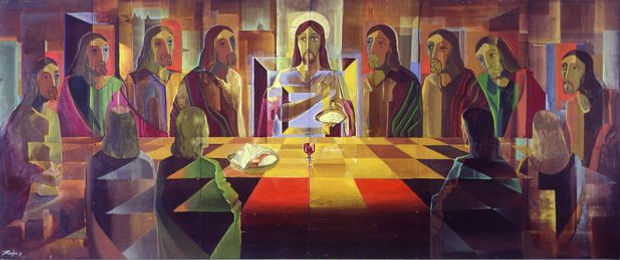
Consider the story that we remember and tell every time we gather for Eucharist.
At the time he was betrayed…; On the day before he was to suffer…; For when the hour had come for him to be glorified by you, Father…Jesus took bread…
Betrayal, suffering and death…quite a story to remember. It speaks of our sins, the betrayals of our Baptismal and Eucharistic Covenants, our sufferings and our own death that we were reminded of on Ash Wednesday, “Remember, you are dust, and to dust you will return.” It speaks of the current betrayal of bishops and priests, the suffering of abuse victims and the dying to arrogance, self-imposed blindness and the putting of institution before children and families that is now needed for healing.
A story not much different than the story each Jew was to tell when offering first fruits at harvest time.
“My father was lost, hungry and wandering. He became a refugee nation, an alien, in a foreign country where we experienced cruel slavery and oppression. In crying out in our affliction, you God brought us to freedom. The thanksgiving we owe for that freedom is found in the thanksgiving we offer for these first fruits of the land and we trust you will continue to be there for us.
Note the Jewish person always speaks in the plural: we, our, us. Listen intently to our prayers. Note also the priest took the offering and placed it before the altar but it was each Jew who told the story because each Jew knew their story and in remembering the past, gave the present and future purpose. The God of Israel who acted in the past is the God who is acting in the present and will act in the future.
Our Catholic past is not the clerical, institutional, devotional and liturgical world of the past. Our past is the stories of sin and redemption. The songs of joy and questioning, hope and repentance found in the psalms. The stories of wandering and being restored; of being lost and then found. A story of death and life.
Lent invites us to remember; to remember who we are and where we came from: David, Bathsheba, Uriah and Absalom, Sarah and Abram, Ruth, Saul, Jacob and Rebecca, Mary and Joseph, Solomon, Moses, Aaron and Miriam, Peter, Mary Magdalene, Ahab and Jezebel, Herod and John the Baptist. Remembering stories of wandering sheep, people and sons and daughters. Remembering stories of slavery and a land of promise; of infidelity, exile and restoration. Without thoroughly knowing and telling these stories for our sake and the next generation there will be no next generation and no reason to offer thanks. Do you know our stories? Do we live out of our stories?
The past must be remembered otherwise we will have no future.
Today, listen and pray intently with me Eucharistic Prayer IV. It is our story.
Jews and Christians do not forgot nor do we whitewash our history as we seem to be doing throughout the world. We remember and tell it all; the good, the bad and the ugly. Only in the truth will we find salvation; salvation rooted in thanksgiving.
Comments