Advent I

Advent I 2016 – Cycle A Isaiah 2:1-5; Psalm 122; Romans 13:11-14; Matthew 24:37-44
Do you judge other people?

Sure you do. We all do, all the time. We make snap judgments about people based on physical looks, fashion, hair style, the presence or not of tattoos and piercings, cleanliness, first encounters – often out of context, race, accents, and stereotypes. By what criteria do you judge people? How accurate do you think our first impression and judgments are of another human being? How many people remain in the prisons of our judgements with no parole or pardon possible? Do you give people another opportunity for you to encounter them? Do you make excuses for people, realizing that everyone has a bad day, other situations are on their mind or a history that weighs heavily on them?
How do you feel when you hear that you’ve been judged, maybe by the same criteria that you use?
Judgment is a double edged sword. Jesus tersely teaches, “Stop judging, that you may not be judged.” But if you are going to judge understand, “as you judge, so will you be judged, and the measure with which you measure will be measured out to you. [Matt 7:1-2]Judgment seemingly is more an activity of humans than of God.
Rather than taking responsibility for our part in judgment, we have created great images of Last Judgment horror over the doorways of the medieval cathedrals, the terrorizing imagination within the paintings of Hieronymus Bosch to Michelangelo’s powerful fresco in the Sistine Chapel. It has been easier to make God the “bad guy” rather than take responsibility. Are these images of horror our own self-reflection?


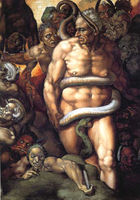
Judgment is an act that we are advised against or carry out at our own peril.
We see this in the situation in John’s Gospel where the Pharisees confront Jesus with a woman caught in the act of adultery. Jesus’ teaching and response to judgment in this situation are telling.
“Let the person among you who is without sin be the first to throw a stone at her.” So Jesus is open to judgment, to the weight of the Law possibly crushing a person. The implicit question is, who has the authority to judge and what are the criteria of judgement?
The story continues with the Pharisees and elders walking away one by one. Then Jesus said to woman, “Woman, has no one condemned you?” She replied, “No one, sir.”Then Jesus said, “Neither do I condemn you. Go and from now on do not sin any more.” [John 8: 4-11] Jesus does judge the woman. She has been caught in the act of adultery. She is guilty. Jesus just finds that her actions are not worthy of condemnation and stoning to death. What might Jesus have known about the woman that we do not? What did Jesus know about the guilty criminal crucified alongside him to whom he promised paradise that we do not?
What Jesus did know was that he and the woman, he and the criminal, were all in the same boat, the same life predicament. Jesus is being set-up, entrapped by the Pharisees just like the woman was entrapped and caught by the Pharisees. Jesus, though innocent, is hanging crucified alongside a guilty criminal who is crucified. Jesus knows what you and I do not want to accept about ourselves and other people. We are all in the same boat of life.
What is there about the people you and I judge that we do not know? Look at your own life’s situation and there you will find the answer.
Of the Four Last Things, including death, heaven and hell, which I have been speaking about in the past weeks, judgment is the last. But there is a dissonance in our tradition.

In the Creed of Nicaea we profess: “I believe in one Lord Jesus Christ…[who] will come again in glory to judge the living and the dead…” In counterpoint, Scripture presents that judgment is a result of our actions. The Book of Revelation states that, “All the dead were judged according to their deeds. [Rev. 20:13] which is confirmed by the parable of the judgment of the nations in Matthew’s Gospel, “whatever you did for one of these least brothers [and sisters] of mine, you did for me.” And “what you did not do for one of these least ones, you did not do for me.’ [Matthew 25:31-46] Yet God reveals through John’s Gospel that Jesus comes to save and heal: For God did not send his Son into the world to condemn the world, but that the world might be saved through Jesus.” [John 3:17]
Pope John Paul II brings some harmony to these dissonant chords when he teaches that judgment is not God’s initiative or plan for us because in his merciful love God can only desire the salvation of the beings he created. In reality, it is we who close or open ourselves to God’s love. Damnation or eternal life consist precisely in being…freely chosen by the human person and confirmed with death that seals our choice for ever. God’s judgment simple ratifies our decision. [See General Audience of Wednesday, 28 July 1999]

Advent is the season in which we are confronted by our sins; by our choices to close ourselves off from God. Advent is also the season when through the prophets we encounter a merciful God who desires our salvation. Desires our salvation so much, that our God became a human being in Jesus of Nazareth to show us the way to God’s self. Death, heaven, hell and judgment wrapped in the Advent dreams of the prophets remind us our Christian life is about choices. Choices that began with a tree: “You are free to eat from any of the trees of the garden except the tree of knowledge of good and evil. From that tree you shall not eat; when you eat from it you shall die.” [Genesis 2:16-17] Choices to open or close ourselves to a relationship with God. The choice of whether we will continue to judge each other knowing that in doing so we are setting ourselves up for judgment.
Comments